Information that changes the way you experience and access content
Effectively
utilizing web sites, mobile or web- based applications, software and hardware.
Accessibility refers to the ability of people with disabilities to have access to and benefit from an entity or system.
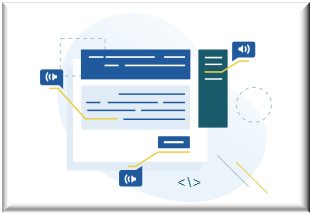
Digital Accessibility refers to the ability of users with disabilities to effectively utilize information technology (IT) systems including web sites, mobile or web based applications, software and hardware. Digital Accessibility is generally concerned with ensuring that IT systems are designed in such a way that they interact appropriately with assistive technologies.
Extensive accessibility legislation is present in most of the major domestic markets including the United States, Canada, the European Union, Australia and Japan. Generally, the relevant portions of accessibility legislation require that organizations make best efforts in order to ensure that physical and electronic business areas can be used by individuals with disabilities.
Most people with severe disabilities use assistive technology in conjunction with core operating system functions to access information in digital systems.
Produced by the World Wide Web Consortium (W3C), the WCAG are the best means of making your website useful to all of your users. Checkout more on WCAG principles, guidelines and conformance levels.
Mobile technologies are developing in leaps and bounds changing the world around. So it’s no surprise they are now used in educational and rehabilitating programs for people with special needs based on accessibility. The whole thing seems pretty basic now, yet we have no doubts its future is bright.
Universal Design is the design and composition of an environment so that it can be accessed, understood and used to the greatest extent possible by all people regardless of their age, size, ability or disability. An environment should be designed to meet the needs of all people who wish to use it.
Universal Design for Learning is an educational framework based on research in the learning sciences, including cognitive neuroscience, that guides the development of flexible learning environments that can accommodate individual learning differences. Checkout the CAST curriculum on UDL.
WAI-ARIA, the Accessible Rich Internet Applications Suite, defines a way to make Web content and Web applications more accessible to people with disabilities. It especially helps with dynamic content and advanced user interface controls developed with Ajax, HTML, JavaScript, and related technologies.
According to the W3C, web accessibility is a practice of removing barriers so people with disabilities can “perceive, understand and interact with the web”. When websites are designed & developed with accessibility in mind, all visitors have equal access to, and can engage with, a site.
Don’t know where to start your accessibility journey? Read this section to find out the world class online and instructor lead training modules that best suits your needs.
Scale your knowledge about the policies, guidelines, testing & implementation techniques shared by the experts in the industry by attending events, conferences & webinars.
Various kinds of simulation can help people understand how low vision or vision loss, mobility challenges and other disabilities can significantly affect their day-to-day activities.
Find out the best resources about accessibility features in desktops & mobile devices. Checkout the popular articles & videos archives on popular assistive technology & screen readers.
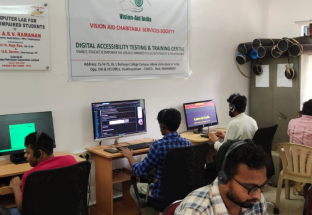
Vissa Sahadeva Rao and Kamala Vissa Vision-Aid Center for Digital Accessibility Testing & Training
We are grateful to our generous donors Sundari and Samir Mitra, of California, USA, for their financial support which helps to cover the cost of training of under-privileged visually impaired students at our center. On October 18, 2020, this virtual center has been named the Vissa Sahadeva Rao and Kamala Vissa Vision-Aid Center for Digital Accessibility Testing & Training to acknowledge their support .